Divine Intelligence, Not Artificial Intelligence, Will Define our Future
Why the next competitive advantage for nations, businesses, and communities will not be smarter machines—but wiser human leadership.
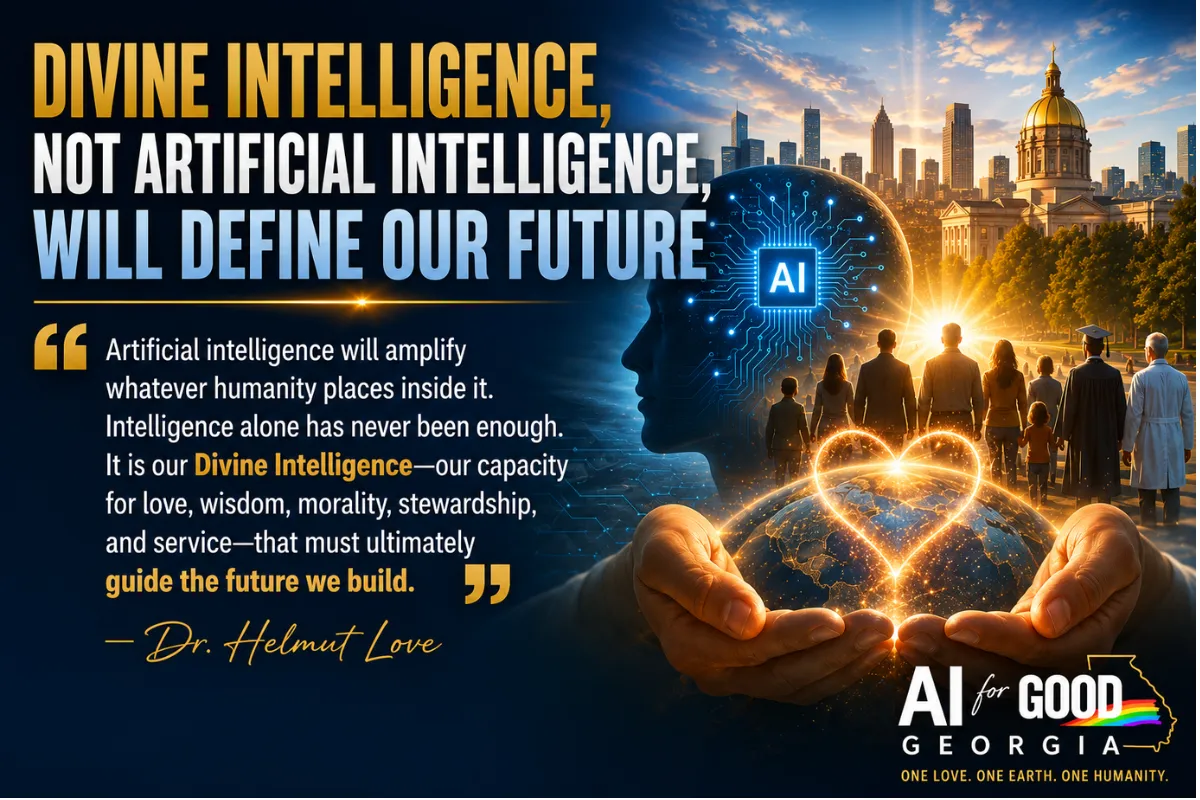
"Artificial intelligence will amplify whatever humanity places inside it. Intelligence alone has never been enough. It is our Divine Intelligence—our capacity for love, wisdom, morality, stewardship, and service—that must ultimately guide the future we build."
— Dr. Helmut Love
The world is asking the wrong question about artificial intelligence.
For the past several years, leaders have debated how intelligent AI will become. They have measured model performance, computational power, automation, and productivity gains. Those conversations are important, but they miss the larger transformation already underway.
Artificial intelligence is not merely changing technology.
It is changing the conditions of human civilization.
Every major technological revolution has reshaped society. The steam engine transformed labor. Electricity transformed industry. The internet transformed information.
Artificial intelligence is different.
It is becoming the connective tissue that will influence nearly every decision made by governments, businesses, educators, physicians, entrepreneurs, families, and eventually every citizen. AI will shape how we learn, diagnose disease, govern communities, allocate capital, educate children, rehabilitate prisoners, counsel patients, hire employees, and even how we understand truth itself.
This is why AI is no longer a technology conversation.
It is a leadership conversation.
And I believe history will remember this era for something far greater than artificial intelligence.
It will remember whether humanity rediscovered Divine Intelligence.
The Leadership Deficit Isn't Intelligence—It's Intention
The greatest misconception about progress is that intelligence alone creates it.
History offers overwhelming evidence to the contrary.
Human intelligence built modern medicine, it also built the atomic bomb.
Human intelligence landed astronauts on the moon, it also engineered financial crises.
Human intelligence connected billions of people through digital networks, it also created algorithms that profit from outrage, addiction, anxiety, loneliness, and division.
Intelligence has never lacked.
Intention often has.
That distinction may become the defining leadership challenge of the twenty-first century.
Throughout history, civilizations have advanced not because they became smarter, but because they developed stronger moral foundations that enabled intelligence to be directed toward the common good.
I describe those foundations as Divine Intelligence.
By Divine Intelligence, I am not referring to one religion, denomination, or doctrine. Rather, I am describing humanity's highest capacities—our ability to love sacrificially, pursue truth courageously, exercise wisdom over impulse, seek justice without vengeance, steward resources responsibly, and recognize the inherent dignity of every human being.
Whether one grounds these principles in faith, philosophy, or shared human values, they represent the qualities that have consistently elevated civilization.
Artificial intelligence now forces us to decide whether these qualities remain central—or become optional.
AI Will Amplify the Civilization We Build
Technology has always been an amplifier. Artificial intelligence simply amplifies faster, farther, and at a greater scale than anything before it.
Every incentive embedded within AI becomes magnified.
If our economic incentives reward attention, AI will optimize attention.
If they reward outrage, AI will manufacture outrage with extraordinary precision.
If they reward fear, AI will learn to generate fear more efficiently than any human marketer ever could.
If they reward human flourishing, AI will become one of history's greatest instruments for expanding opportunity.
Artificial intelligence will not determine our future.
Our incentives will.
That realization should fundamentally change how executives, policymakers, educators, investors, and entrepreneurs approach AI strategy.
The real competitive advantage will no longer belong solely to organizations with the best technology.
It will belong to organizations with the clearest values.
Trust will become infrastructure.
Character will become a strategy.
Purpose will become an economic advantage.
From Co-existing to Co-Creating
Artificial intelligence introduces another unprecedented challenge.
For centuries, societies have learned to coexist despite profound differences.
The AI era requires something much more ambitious.
It requires humanity to co-create.
No government can regulate AI alone.
No company can responsibly develop it alone.
No single political ideology possesses every answer.
No faith tradition has a monopoly on wisdom.
The future of AI will emerge from the collective decisions of billions of people designing systems that increasingly shape billions more.
That reality demands a new model of leadership.
Not leadership built upon ideological victory.
Leadership built upon shared purpose.
We will continue to disagree about politics.
We will continue to debate economics.
We will continue to hold different theological convictions.
That diversity is not our greatest threat.
Our greatest threat is forgetting what we already share.
Across civilizations, cultures, and generations, humanity has repeatedly returned to remarkably similar principles: dignity, truth, compassion, justice, responsibility, freedom, stewardship, accountability, and love.
These are not merely ethical aspirations.
They are design requirements.
Without them, artificial intelligence will simply magnify our lesser humanity.
Why Georgia Can Lead
This is why Georgia matters.
Georgia occupies a uniquely balanced place within America.
We are home to global corporations, world-class research universities, thriving entrepreneurs, diverse communities, communities of faith, nonprofit leaders, educators, healthcare innovators, policymakers, and one of the fastest-growing technology ecosystems in the country.
Just as importantly, Georgia reflects the diversity of America itself.
Urban and rural.
Progressive and conservative.
Deeply spiritual and highly innovative.
That balance positions Georgia to become something larger than another AI hub.
Georgia can become the nation's laboratory for human-centered AI leadership.
Rather than asking only how AI can improve efficiency, Georgia has the opportunity to ask a more consequential question:
How can AI improve humanity with our collective Divine Intelligence?
That shift changes everything.
And it requires us doing so without apology for our most human of aspects: our Spirituality.
What happens when we unite in belief in the One Love that is common across our traditions?
In a world that has seemingly forgotten the love of God, neighbor and self, Georgia must move with urgency to preserve the kind of world our ancestors and veterans died for.
Preserving the Best of Capitalism
Some assume that discussions of ethics require abandoning markets.
History suggests the opposite.
Capitalism has been one of humanity's greatest engines of innovation, entrepreneurship, prosperity, and personal freedom.
Those strengths should be protected.
But capitalism functions best when markets operate within cultures of trust.
The healthiest economies are built upon healthy people.
Healthy families.
Healthy communities.
Healthy institutions.
Artificial intelligence invites us to build what I would call Responsible Capitalism—an economy where innovation accelerates prosperity without exploiting psychological vulnerabilities.
Today we routinely monetize addiction, distraction, polarization, insecurity, and loneliness.
Too often we celebrate this as innovation.
Imagine instead designing AI that helps children develop resilience rather than dependence.
Educational systems that cultivate curiosity instead of passive consumption.
Mental health platforms that restore dignity rather than simply manage symptoms.
Correctional systems focused on rehabilitation instead of recidivism.
Healthcare that strengthens the relationship between physician and patient instead of replacing it.
Technology should not simply optimize efficiency.
It should optimize human flourishing.
That is both a moral aspiration and a long-term economic strategy.
The Legacy of Our Generation
As America celebrates our 250th anniversary, we find ourselves standing at one of history's defining inflection points. Every generation eventually answers one question.
What did you build with the opportunities you were given?
I often think about how future generations will remember ours.
They will not remember us because we invented artificial intelligence.
They will remember whether we guided it wisely.
Whether we protected children.
Whether we strengthened families.
Whether we built economies that rewarded both innovation and integrity.
Whether we chose cooperation over division.
Whether we expanded opportunity instead of concentrating it.
Whether we remembered that every person possesses inherent dignity—not because of productivity, wealth, intelligence, or influence, but because they are human.
Every major faith tradition expresses a version of the same enduring truth:
What we do to our neighbor, we ultimately do to ourselves.
Artificial intelligence transforms that spiritual principle into strategic reality.
Because in an interconnected world, no society can sustainably flourish while large portions of its people are left behind.
Our collective future will increasingly reflect how we treat the most vulnerable among us.
A New Measure of Intelligence
Artificial intelligence will undoubtedly become one of history's greatest achievements.
But it will never be humanity's greatest intelligence.
That distinction belongs to something far older and far more enduring.
Divine Intelligence.
The wisdom to choose love over fear.
Service over selfishness.
Stewardship over exploitation.
Truth over convenience.
Courage over complacency.
This is the intelligence that built every great civilization.
It is the intelligence that will determine whether AI becomes history's greatest accelerator of human flourishing—or humanity's greatest missed opportunity.
The future will not belong to those who build the smartest machines.
It will belong to those who possess the wisdom to ensure those machines serve what is highest within us.
The question before us is no longer whether artificial intelligence will transform the world.
It will.
The question is whether Divine Intelligence will transform us first.
About Dr. Helmut Lucero Love
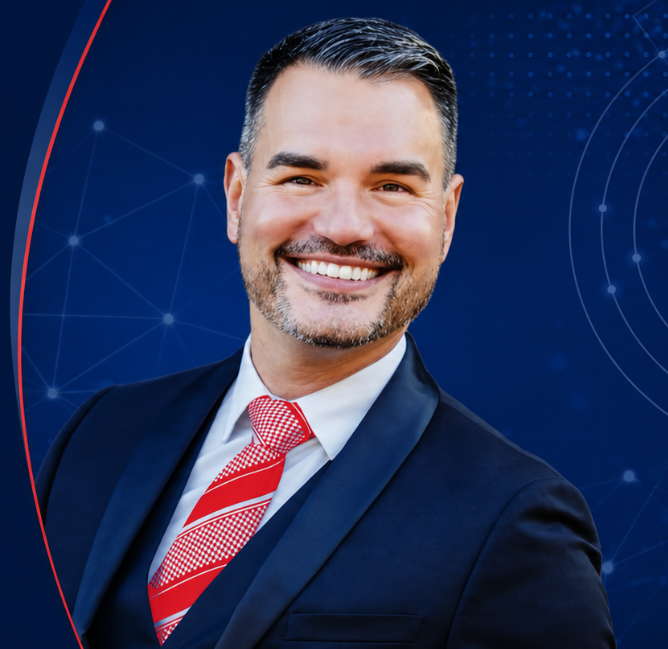
Dr. Helmut Lucero Love is a community leader, entrepreneur, educator, and technology innovator whose work focuses on helping people, businesses, and governments use artificial intelligence to improve lives and expand opportunity. He is the founder of AI-for-Good Georgia, The Gayly Impact, The Gayly Dose—named Atlanta Magazine's #1 Podcast in 2023—and The Leadership Impact Institute.
AI-for-Good Georgia is a nonpartisan statewide initiative dedicated to advancing human-centered artificial intelligence that creates opportunity, strengthens communities, and improves lives. Sponsored by The Gayly Impact, Inc., a 501(c)(3) nonprofit organization, the initiative works across sectors to ensure artificial intelligence serves the public good through education, innovation, and community leadership.
Dr. Love holds a biomedical engineering degree from Texas A&M University, an MBA from Northwestern University's Kellogg School of Management, and an honorary doctorate from Harvest Christian University.
Learn more about Dr. Love's Artificial Intelligence (AI) strategy consultancy at DrHelmutLove.com, his book at Wake Up Your Life Magic his campaign at HelmutLovesAtlanta and his new YouTube channel and podcast, Pure Possibility Politics. Follow him on Instagram at @drhelmutlove and @helmutlovesatl.